
The Graph Data Council (GDC) is nearly fifteen years old. During this period, the organization has undergone quite a few changes, including to its organizational structure, finances, and branding. In this blog post, we summarize the organization’s history and present its current state and goals.
Research Project (2012–2015)
LDBC started as a European Union-funded FP7 research project by the same name with the participation of four academic and four industry partners. The project was coordinated by Josep Larriba Pey (Universitat Politècnica de Catalunya) and Peter Boncz (CWI & VU Amsterdam).
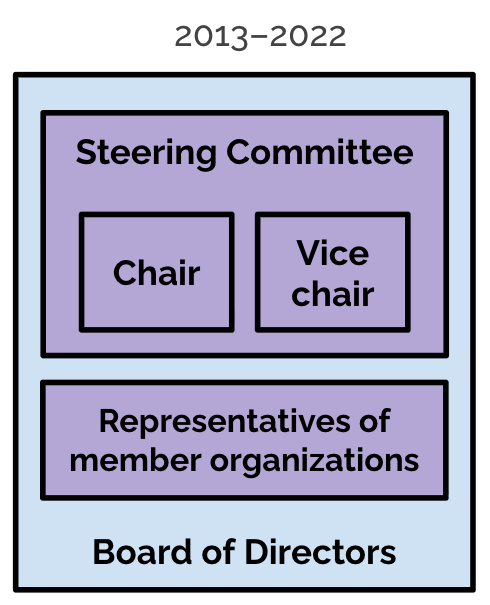
The consortium established the non-profit organization Linked Data Benchmark Council and registered it in the United Kingdom. The organization was led by the Steering Committee with Josep Larriba Pey and Peter Boncz appointed as the project’s chair and vice-chair, respectively. Member organizations nominated their representatives to the Board of Directors.
Over these years, we designed the Social Network Benchmark suite and released its first workload, SNB Interactive. We also designed the Semantic Publishing Benchmark (SPB) with a workload based on BBC’s real-world ontology. We conducted standard-establishing audits using GraphDB, Virtuoso and Sparksee, and created an early draft implementation of the SNB Business Intelligence (BI) workload.
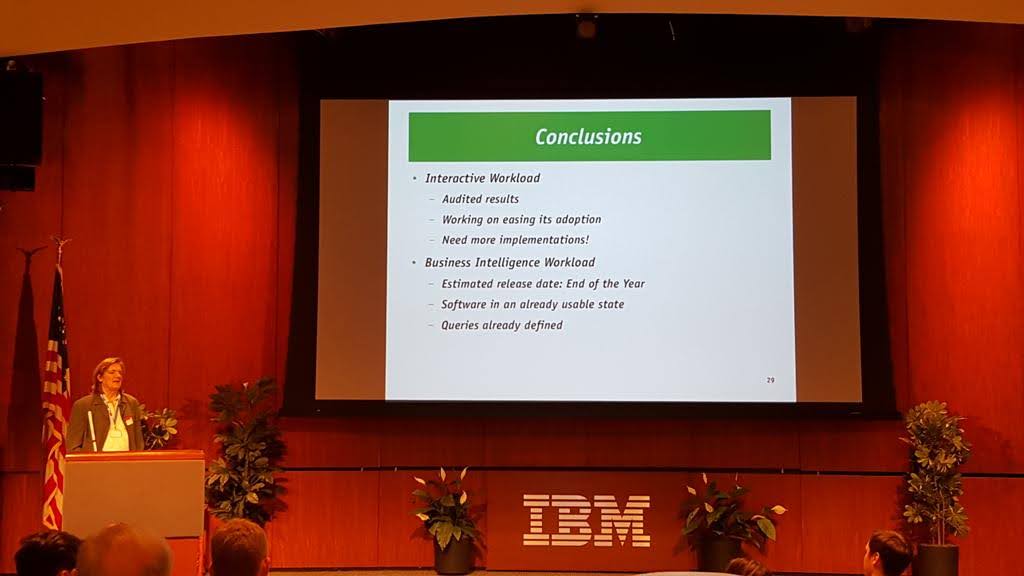
Orri Erling presenting the SNB workloads in 2015
Sustained Research Efforts (2016–2018)
After the successful conclusion of the EU project, research efforts continued but their focus shifted to query languages. This was motivated by an earlier observation: during the benchmark design, we realized that a major blocker in the adoption of graph technology and the design of benchmarks is the lack of a standard graph query language. Therefore, through a multi-year collaboration between academia and industry, LDBC created G-CORE, a design language. Our goal was to create a query language from first principles: visual graph syntax, focus on composability, and treating paths as first-class citizens.
In 2017, the international standards committee responsible for the SQL database language standard (ISO/IEC/JTC 1/SC 32/WG 3 “Database Languages”) established a Category C Liaison relationship with LDBC. This liaison allows WG 3 to share its working documents, draft specifications, and draft digital artifacts with LDBC participants, giving them early visibility into standards development efforts. It has also made the SC 32/WG 3 work more visible to LDBC member organizations and gave G-CORE more visibility in the Database Language standards process, which allowed it to influence the design of the ISO GQL and SQL/PGQ languages.
The benchmark task forces were also active. The Graphalytics task force, led by Alexandru Iosup at VU Amsterdam, designed the LDBC Graphalytics benchmark for graph analytics and organized several Graphalytics competitions. The Social Network Benchmark task force created the first paper on the SNB Business Intelligence with preliminary benchmark results and published it at GRADES-NDA 2018.
During this phase, the organization did not collect any membership fees. Instead, members continued contributing their work (research, programming, etc.), while the organization’s IT and administration were supported by CWI and Sparsity.
Expansion and Auditing Ramp-up (2019–2022)
From 2019, companies reached out to us and commissioned audits for the SNB Interactive workload. Thanks to the work on new benchmarks and the many audits conducted in this period, LDBC’s benchmark design process and auditing process crystallized. The SNB task force completed the BI workload’s standard-establishing audits, and the first real-life audit, sponsored by a collaboration between AMD and TigerGraph.
Thanks to the wide interest in audited benchmark results as well as LDBC’s work on schema and query languages, our membership grew from approximately seven organizations in 2019 to 22 organizations in 2022. Alastair Green became LDBC’s vice-chair and began setting up the organization’s finances to collect membership fees. This seemingly trivial matter posed a surprisingly difficult hurdle for an organization with many directors – one per member organization at the time – of 10+ different nationalities. However, once this hurdle was cleared, we could finally collect membership fees and start professionalizing the organization and our events.
We established a new working group to research property graph schemas (PGSWG), which produced the PG-Keys paper, published at SIGMOD 2022. Several LDBC members also contributed to establishing the semantics of SQL/PGQ and GQL.
The Social Network Benchmark task force, led by Gábor Szárnyas, finalized the SNB Business Intelligence workload and submitted it for publication to VLDB. At the initiative of Ant Group, a new task force was set up to design the LDBC Financial Benchmark suite with the first workload focusing on high-throughput transactional distributed systems.
Meanwhile, we were also asked to scrutinize some earlier, unsanctioned benchmark results. We conducted and published retrospective reviews on these. To make sure that the benchmarks are used as intended in the future, we trademarked the term “LDBC Benchmark Result” and published a Fair Use Policy for our benchmarks.
Restructuring and Continued Work (2023–2024)
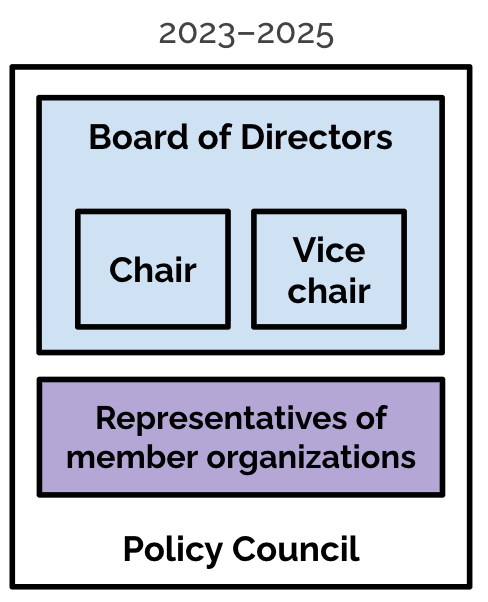
In early 2023, the organization was restructured to simplify governance and avoid issues with having too many directors on the board. In the new structure, the existing Steering Committee was replaced by a smaller Board of Directors (3–5 representatives), while the voting body of representatives became the Policy Council. From 2023 to early 2024, Oskar van Rest of Oracle served as the chair of the organization.
In this period, the benchmark task forces released the initial version of the Financial Benchmark, created a preliminary version of the SNB Interactive v2.0 workload, and organized a new Graphalytics competition.
The schema working group produced the comprehensive PG-Schema paper, which won the Best Industry Track Paper award at SIGMOD 2023. The paper on the SNB Business Intelligence workload won the Best Paper award at VLDB 2023’s benchmark track.
LDBC started investing in creating open-source software to aid the adoption of GQL and launched the LDBC Open GQL Tools.
Rebranding and New Fee Structure (2025–present)

In 2025, Henry Gabb, who was formerly Intel’s representative, became the chair of the organization.
We rebranded the organization to Graph Data Council (GDC) to better reflect our broad focus on graph data management, which extends well beyond Linked Data and RDF technologies. We launched a redesigned website.
At the beginning of the year, we reworked our membership fees and moved to a tiered system, which provides GDC with a larger financial buffer for open-source work, event organization, and compensation for board members. Auditing activities continued with record-breaking results for SNB Interactive.
The Financial Benchmark was published at VLDB 2025, where it won the Best Paper Runner-Up award in the benchmark track. Alastair Green and Shipeng Qi led the setup of the Text2GraphQuery working group, which aims to study the problem of generating graph queries from natural language.
To help set directions for 2026, the Board conducted a Membership Survey and published the findings in a report.
Conclusion
In this blog post, we looked back upon the history of the Graph Data Council. We presented its evolution from a research project through a small nonprofit to a sizable open-source organization focused on graph processing technologies. In the coming years, we look forward to expanding our benchmark offering and exploring topics around graph schema and query generation.